Architecting Teams for High-performance Outcomes & Scale
I don’t need to own the company. I need to own the impact.
The Philosophy
Leadership
Product Development
AI Evolution
What Changes
Engage
Explore The Origin
Engineering
EXPLORE ↓
THE HUMAN IN FOCUS
Leadership Culture Architecture
Ownership culture. Not management. Architecture.
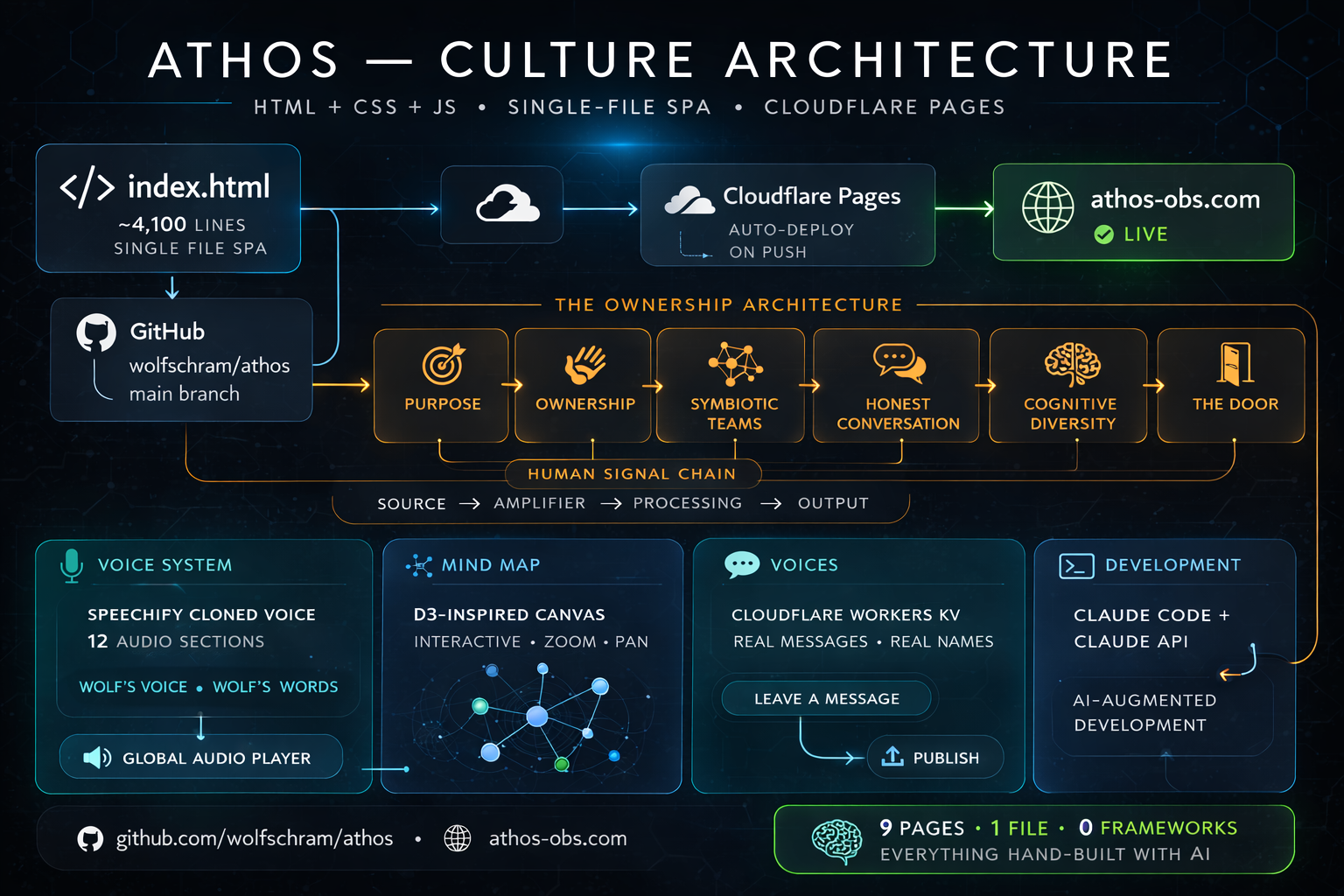
THE OWNERSHIP ARCHITECTURE
Six conditions that determine whether a team genuinely owns its outcomes — or just goes through the motions.
Think of it as a signal chain. In broadcast engineering, every signal passes through a chain of connections from source to destination. One bad link and the whole chain fails. Culture works the same way. Purpose is the source. Ownership is the first amplifier. Symbiotic Teams, Honest Conversation, and Cognitive Diversity are the processing chain. The Door is the output — what leaves your system and enters the world.
My voice, my words, my view
100%Click any node to focus
THE RESTLESS MIND
My AI Evolution
Need → Build → Learn → Pivot → Build Again.
THE RESTLESS MIND
My brain does not sit still. It never has. When I was a kid, that was a problem — school is not built for a mind that needs to understand why before it can learn how, that gets bored the moment something stops being new, that sees twenty connections where most people see one. It took me decades to stop seeing that as a flaw and start seeing it as an engine.
AI changed something for me. Not because it made me smarter — but because for the first time, I had a tool that could keep up with the pace of how I think. I could have an idea at midnight, describe it out loud, and have something real to look at by morning. The gap between concept and reality — the gap that had always exhausted me — collapsed. And what came out of that collapse was everything you see below.
On a scale of 1 to 10 as an AI professional, I would put myself at a 1.5. There is so much I have not touched the surface of. These projects might look impressive to someone who has not tried — but that is the one-eyed among the blind. What they represent is not technical mastery. They represent what happens when a restless mind finally finds a way to build the things it has always been able to see.
Every project below was born from a real need. Not an exercise. Not a tutorial. A genuine problem that needed solving and nothing that existed could solve it. Some worked. Some failed spectacularly. Each one taught something the next one needed. That is the ADHD brain in its natural habitat — not distracted, but driven. Not scattered, but searching. Always searching.
01 — THE SPARK
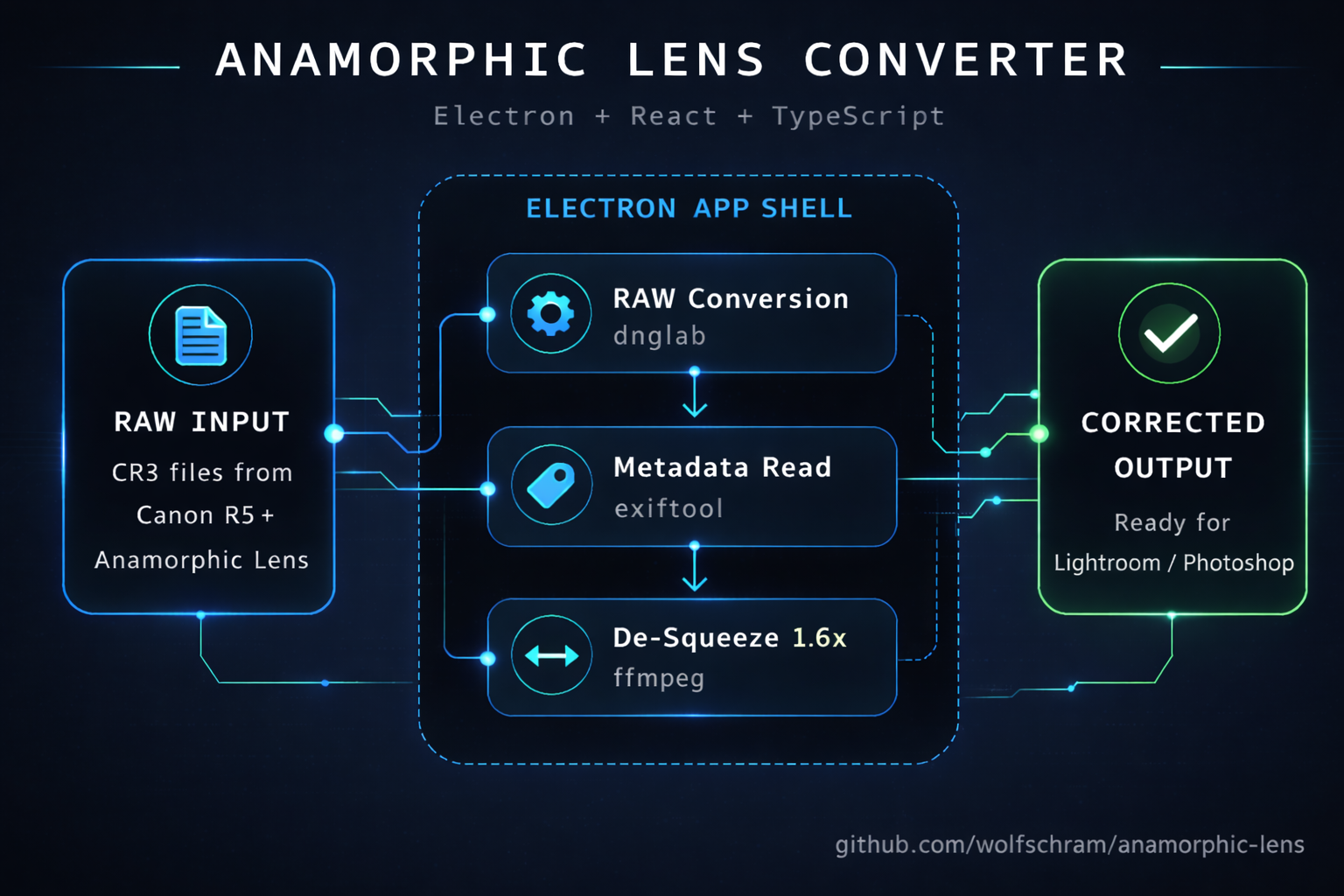
Anamorphic Lens Converter
▾
STACK
ElectronReactTypeScriptdnglabffmpegexiftool
The need: Photography shot with a fully manual anamorphic lens produces squeezed images. Every frame needs de-morphing before editing. After research — nothing existed to batch-process this.
Why it matters: First time I said “Hello Claude, build me something” — and it worked. A real tool solving a real problem. The spark that lit everything that followed.
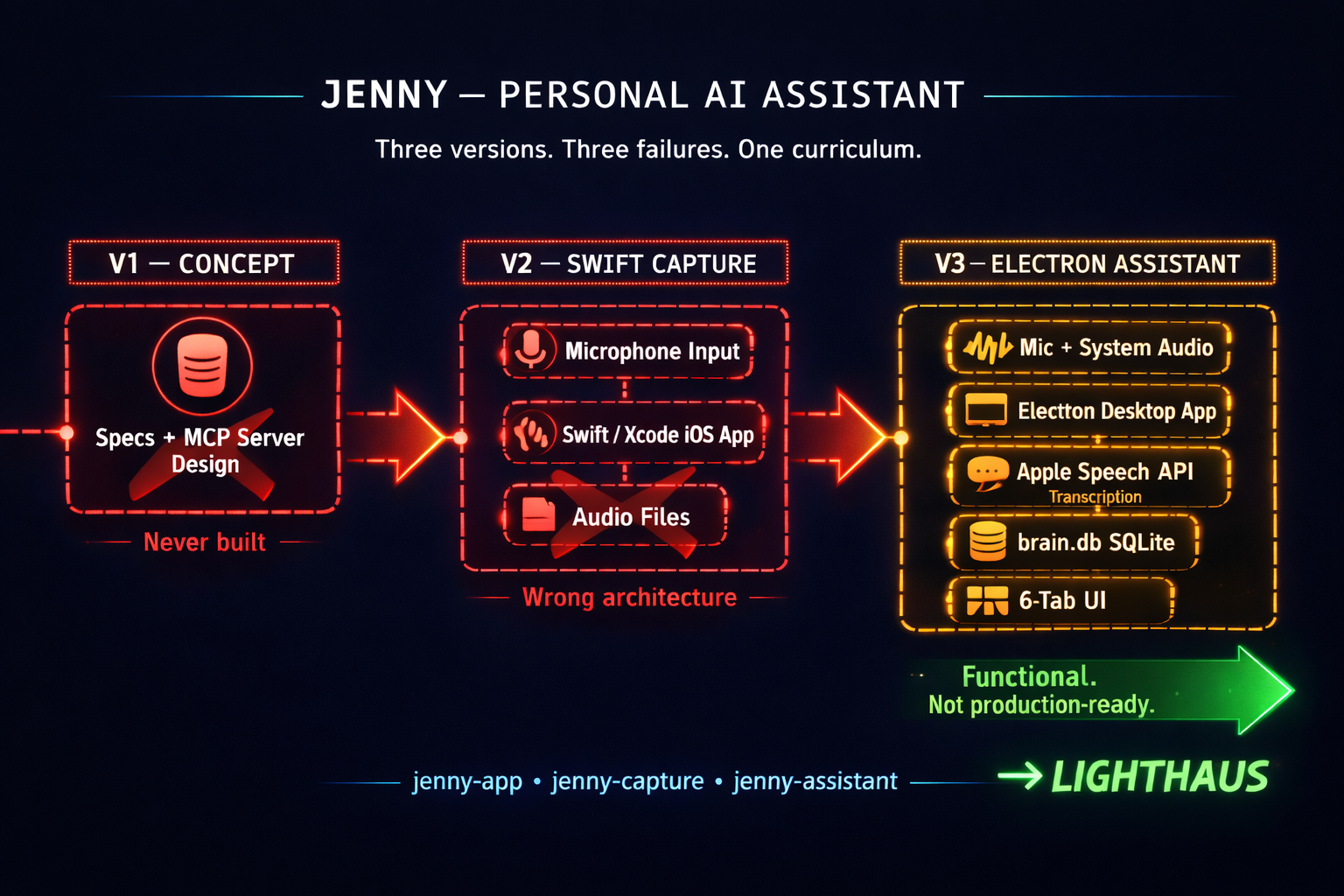
Swift / XcodeElectronReactTypeScriptSQLiteClaude APIMCP Server
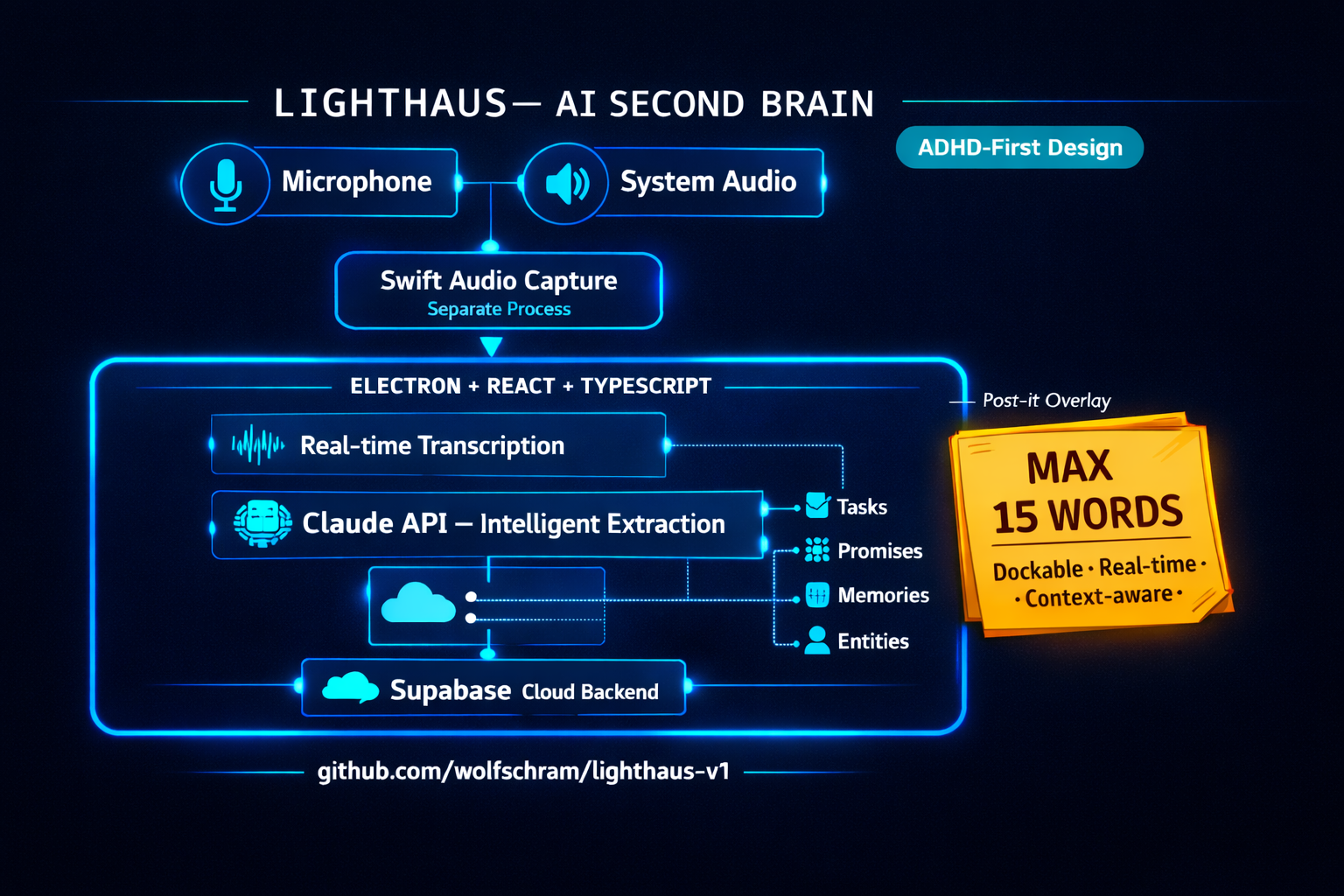
The need: An AI second brain. Something that captures what I say, understands what matters, and helps me remember what my ADHD brain forgets. Nothing on the market was designed for neurodivergent minds.
What I built: Three versions. v1: concept docs + MCP server spec. v2: Swift/Xcode iOS audio capture. v3: Electron desktop app with SQLite brain.db. Each closer than the last.
What failed: All of it. None became a usable product. The vision was right but the execution kept hitting walls I didn’t know existed yet.
What I learned: Failure is the fastest teacher if you’re honest about it. Most people quit at attempt three. The breakthrough comes after you stop blaming the tools and start understanding the problem.
The need: Same as Jenny — but this time I understood the problem well enough to solve it. ADHD-first design as the core principle: every feature asks whether it reduces cognitive load or adds to it. If it adds, it doesn’t ship.
What it proved: Twenty failures lead somewhere if you don’t quit. First tool built entirely with AI assistance that works in daily use. The post-it overlay — max 15 words — surfaces the right context at the right moment.
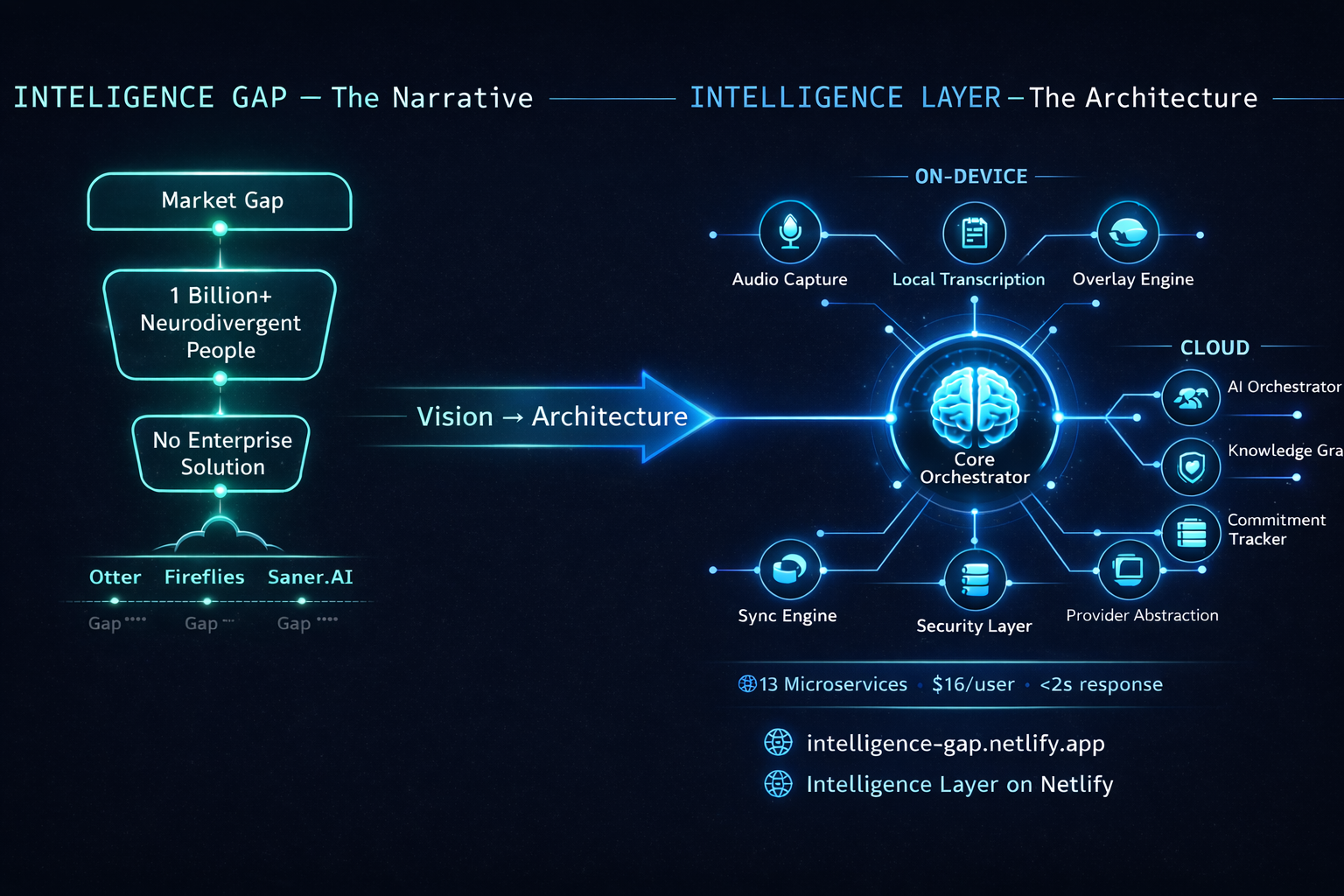
The need: Lighthaus worked as a personal tool. Could it become a product? If I can’t sell the app, maybe I can sell myself to sell the app. Nobody was building AI assistants focused on neurodivergent people.
What I built: The Intelligence Gap — strategic vision mapping the gap between AI capability and human understanding. The Intelligence Layer — deep technical architecture with 13 microservices, hybrid processing, $16/user cost model.
What happened: Neither led to a commercial outcome. Reached out to CEOs on LinkedIn — heard nothing. The market is overloaded with people having their second spring with AI. But the concept is still valid.
What I learned: Narrative alone doesn’t sell. Architecture alone doesn’t sell. What sells is proof of work and the ability to adapt when the world moves faster than your plans.
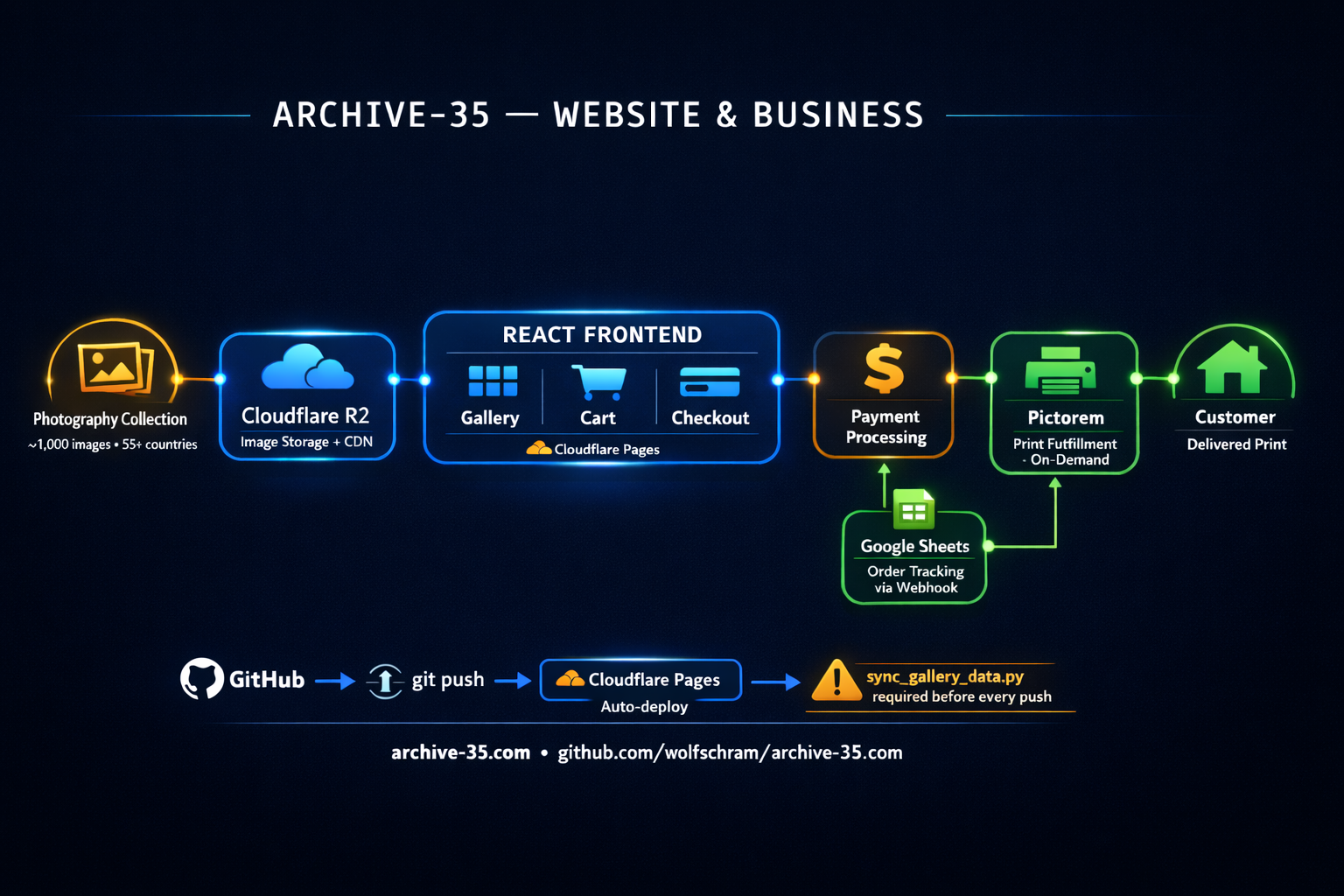
The need: 25 years of photography from 55+ countries. ~1,000 curated images sitting on hard drives. Time to bring them to the world as fine art.
What I built: React frontend on Cloudflare Pages. Python FastAPI agent. Electron + React Studio desktop app. Node.js mockup service. Stripe payments. Pictorem print fulfilment. Two-machine workflow — MacBook Pro as creative workstation, Mac mini as render server.
Why it matters: First truly complex multi-system build. Three services sharing data — change one, test all three. Live with real customers and real payments. Not a prototype.
What it taught: How to build properly. How systems depend on each other. How to manage complexity across codebases. Everything after was faster because of what this demanded.
ElectronReactTypeScriptPython FastAPINode.jsSQLiteInstagram APIPinterest APIEtsy APIClaude API
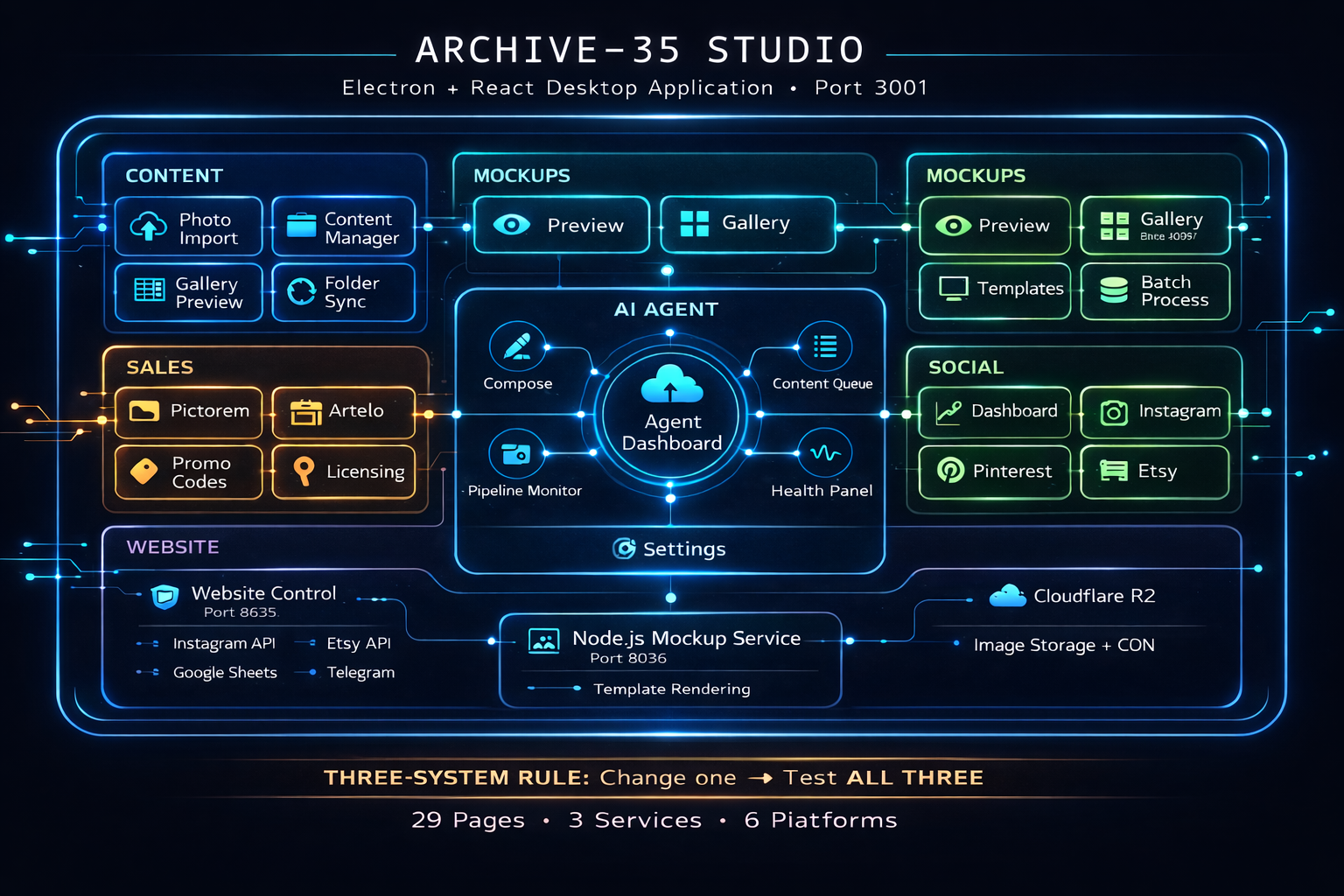
The need: The website alone isn’t enough. Managing a photography business means content ingestion, mockup generation, social media posting, sales tracking, gallery submissions, website control, and AI-powered content creation. All from one place.
What I built: A full desktop application with 29 pages organised into 6 clusters: Content management (import, gallery, sync), Mockups (preview, templates, batch processing), Sales (Pictorem, Artelo, promo codes, licensing), Social & Marketing (Instagram, Pinterest, Etsy integrations), an AI Agent system (dashboard, compose, content queue, pipeline monitor, health panel, CaFÉ export), and Website Control (live control panel, about editor, analytics).
The infrastructure: Three interconnected services that share data. The Electron Studio app on port 3001. A Python FastAPI agent on port 8035 handling Instagram, Pinterest, Etsy, Google Sheets, and Telegram integrations. A Node.js mockup service on port 8036 for template rendering. The three-system rule: change one, test all three.
Why it matters: This is the most complex thing I’ve built. 29 pages, 3 services, 6 platform integrations, all communicating. The architecture came from my engineering brain — in the macro world it works one way, in the micro world of code, the same principles apply.
07 — INDUSTRY DEEP DIVE
Broadcast Routing Intelligence
▾
STACK
Claude APIReactCloudflare PagesSMPTE 2110IPMX / NMOSBroadcast domain expertise
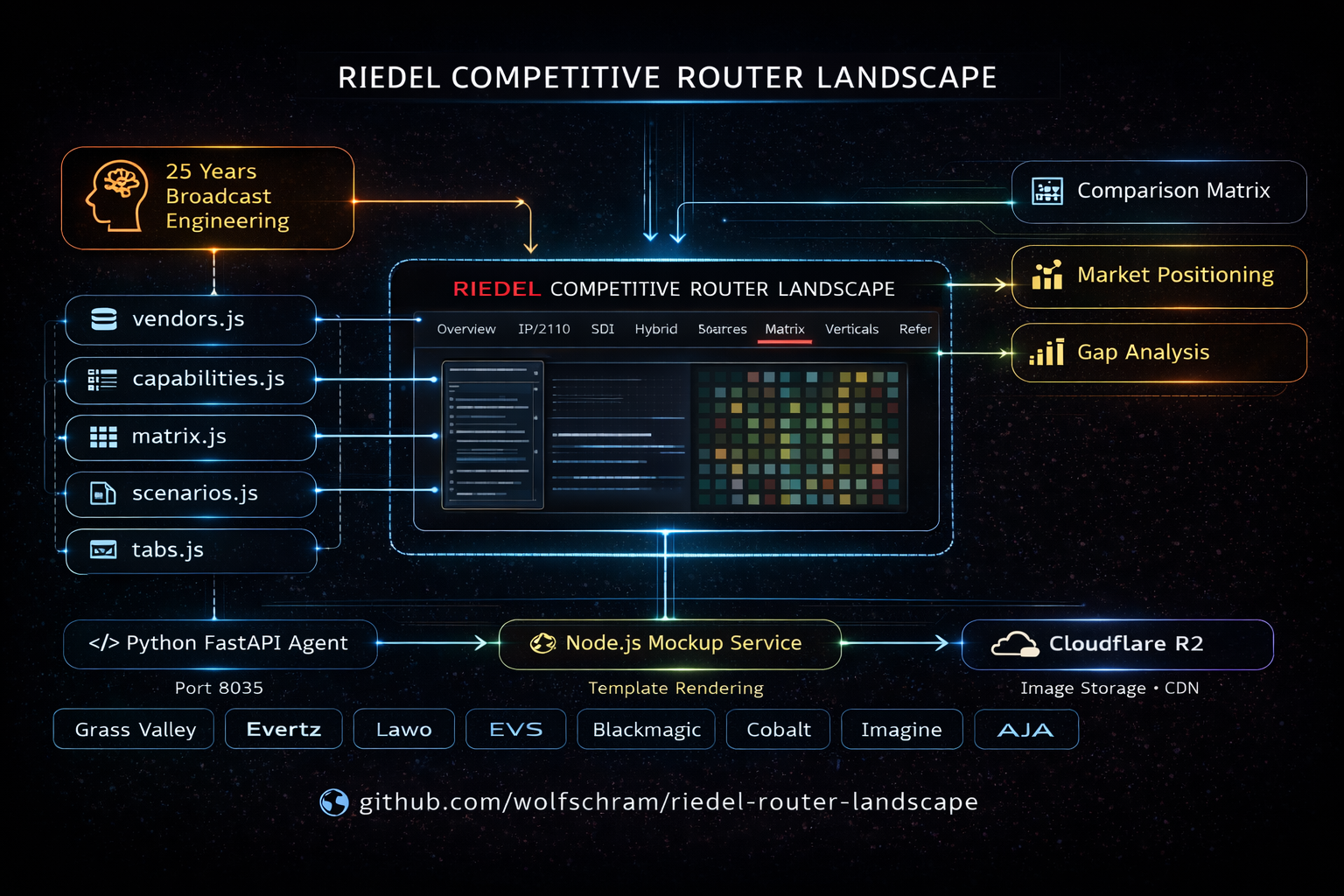
The need: A major broadcast manufacturer needed competitive intelligence across the entire IP routing vendor landscape — IPMX, SMPTE 2110, where the industry is heading.
What I built: Full competitive analysis platform. Research across Grass Valley, Evertz, Lawo, EVS, Blackmagic, Cobalt, Imagine and more. Interactive visualisations. Vendor comparison matrices. Market positioning analysis.
Why it matters: Proved the intersection of domain expertise and AI-augmented building. I sat with them, had done my homework, and could answer questions that came easy because of 25 years in the industry. Built in days, not months.
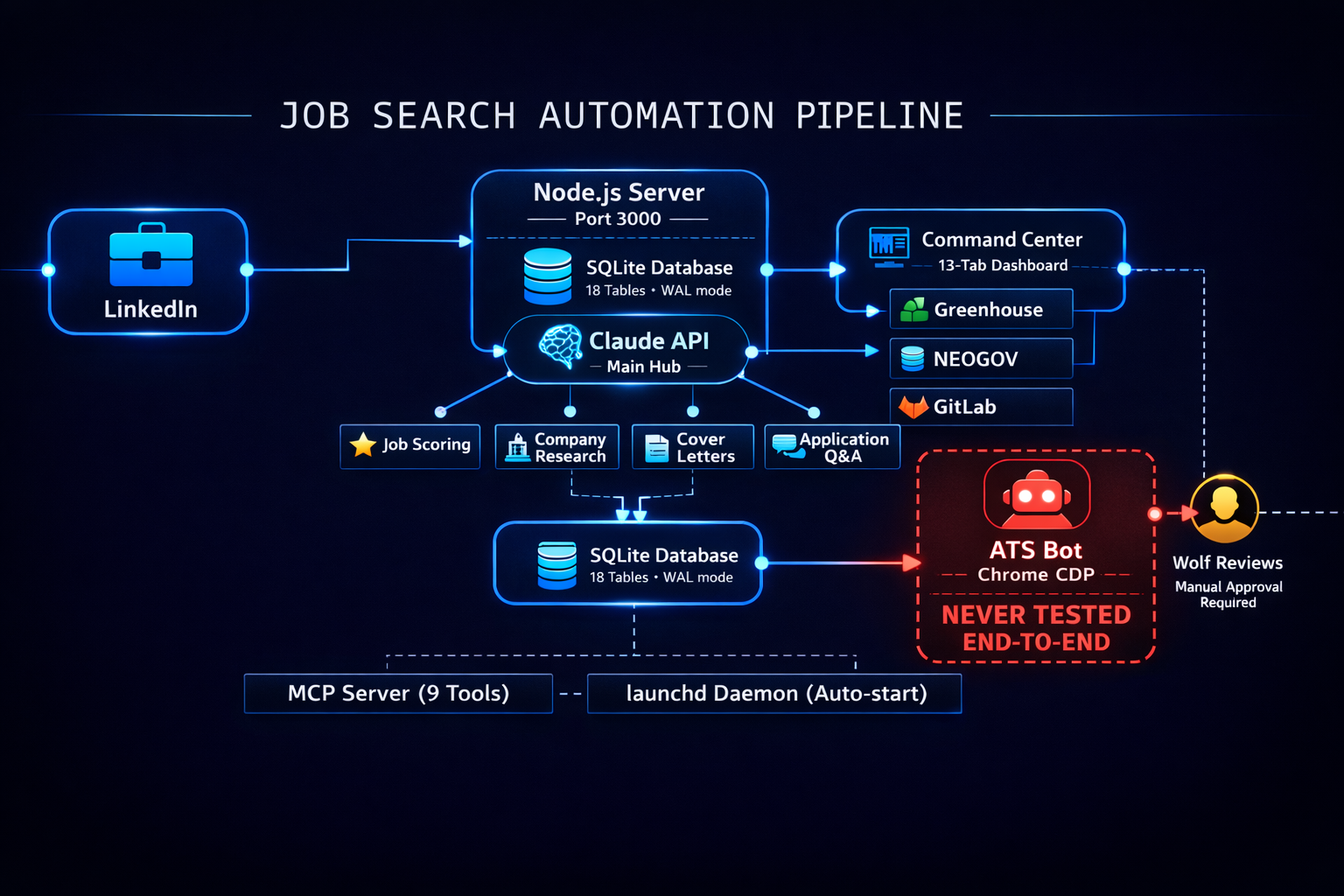
The need: Job searching is tedious and draining — especially with ADHD. Automate the pipeline: Claude scores listings, researches companies, drafts cover letters. A bot submits. A dashboard tracks everything.
What I built: Node.js server. SQLite with 18 tables. 13-tab command center. Gmail OAuth. Claude API for scoring and cover letters. MCP server with 9 tools. Auto-start daemon.
What failed: The ATS bot has never been tested end-to-end on a real application. Every platform actively fights automation — and they’re better at it than me. Ambitious but fragile.
What I learned: Automation without reliability is just complexity. Building something that works sometimes is worse than building something simple that works always.
The need: After all the failures and successes, pivots and breakthroughs — what do you do with everything you’ve learned?
The answer: You teach it. You share it. You help others make the same transformation. Not from a whitepaper — from lived experience. From doing it, failing at it, succeeding at it, and documenting all of it.
Culture architecture informed by 25 years of leadership and months of intensive AI-augmented building. The Restless Mind doesn’t stop. There will be a Project 10.
It started with running tapes. Literally. I was a runner at a TV station in Berlin in the late nineties — the elevators were unreliable, and when content arrived that needed to go on air three minutes later, you paid a young guy to sprint up the staircases between the master control room and the sports division on the fourth floor. That was me. I did not mind. I was inside the building, and I was watching everything.
From there I taught myself into the MCR. Not running it — operating it. Running into things I had no idea how to do and figuring them out by doing them. Satellite transmissions. Live conferences over bundled ISDN lines. The kind of work where the uplink window is fixed and there is no version two. Then a different TV studio, where I sat in every seat I could find — audio desk, live switching, graphics, camera shading, teleprompter, VTR. Not because anyone told me to. Because I needed to understand how it all connected.
The moment that changed how my brain works permanently was a signal flow diagram on the wall of the equipment room at a TV station in the Sony Center, Berlin — around 2001. Every signal. Every path. Every DA, every converter, every destination. Drawn out, clear, complete. For a visual thinker, it was like someone handed me the map I had always been building in my head. I stood there and overlaid everything I already knew onto that drawing. That is how I learned to think about systems — visually, end to end, no gaps. That instinct has never left me.
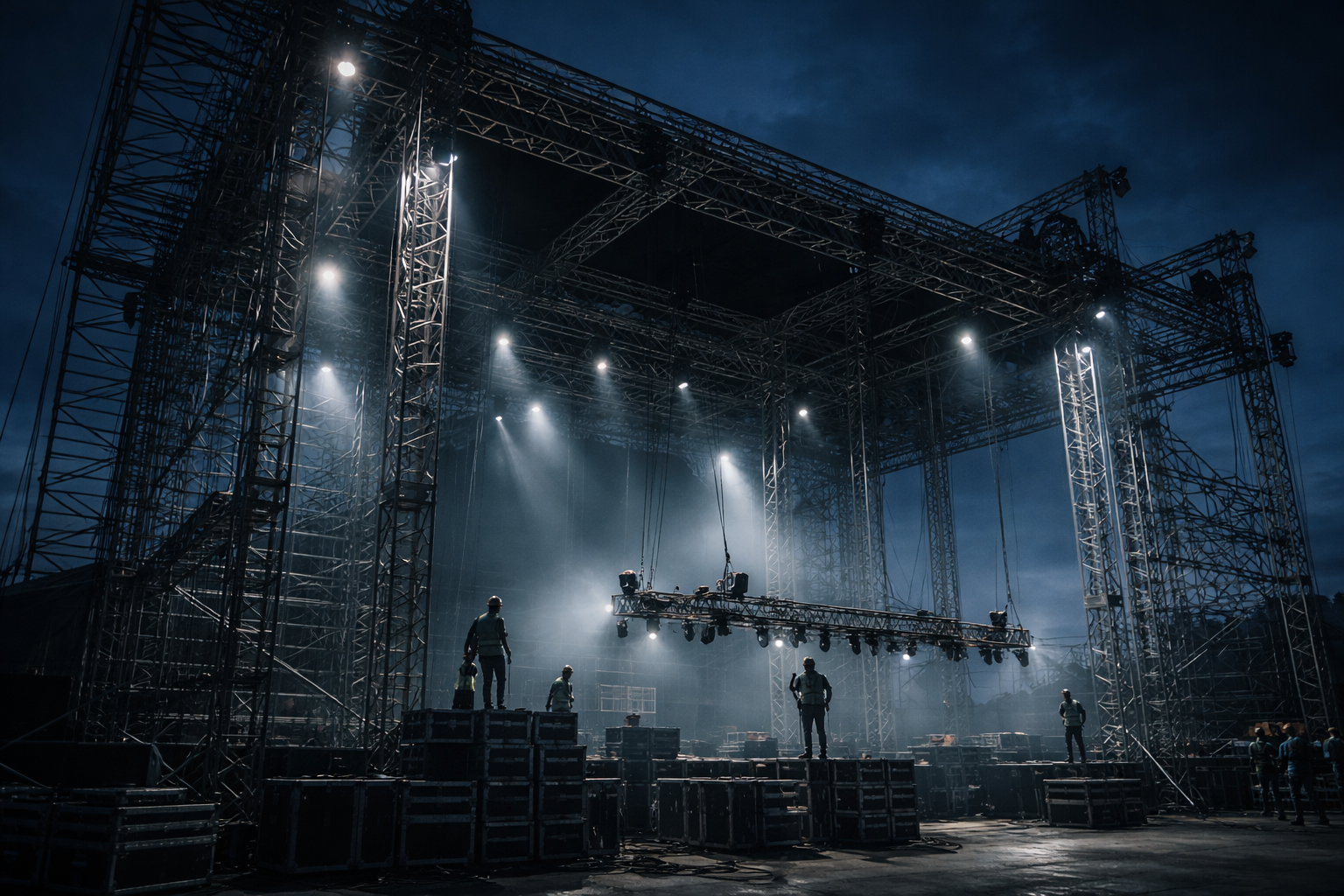
After the studios, I moved into event production at a rental house in the early 2000s. Building fly-pack systems from single components for exhibitions, gala dinners, corporate events. The work looked different every time: you show up with a truck full of parts, you build a functioning system for that event, and then when it ends, you break it all back down into individual boxes and pack it away. Like it never happened. And then you do it again, somewhere else, for something different. The constant rebuilding forced you to re-trace signal flow from scratch every single time. Where is it coming from, where is it going, what happens in the middle. Those are the rules. I have never stopped asking those questions.
That same era taught me something that I carried into everything that came after. In the events world I was doing everything — building the fly-pack, running the system, and whenever I could, cutting the show. Acting as TD while also being the systems person. One day a Director pulled me off the switcher mid-show and brought in someone whose entire skill was cutting. It was a punch in the face. My ego took the hit.
Sitting with it, I understood something that changed how I worked: being good at systems is not the same as being good at cutting. A real TD reads the room before the camera does — thinking three shots ahead, feeling the rhythm of a show the way a conductor feels an orchestra. That is a different brain. Not better or worse. Different. I was not that brain. I was the systems brain. From that moment, I stopped trying to be both. When someone asked me to cut, I said: I’m not good at that. You want someone else. I’m good at the systems. And something unexpected happened — they trusted me more. Saying what you are not is the most credible thing you can say in a room full of people pretending to be everything.
I am not a 2110 specialist — and I want to be honest about that. I can sit in a room and have a real conversation about whether IP infrastructure is the right path: the need, the cost, the risk, the timing. I have led the people who build those networks. But I am not the person you bring in to architect the solution. What I am is the person who knows enough to ask the right questions — and to know whether the person answering them actually does.
CONCERT TOURING
I came into concert touring having already settled who I was: the systems person, not the TD. That understanding was the foundation, not something I found along the way. In the touring world the Director and TD are usually the same person — broadcast separates them, touring rarely does. Which meant my role was clear from the start: be the technical partner. When a director wanted to do something interesting on the switcher, they came to me. We worked out how to technically achieve what they were imagining. Translating artistic vision into a signal flow solution in real time — that was the work I was built for, and I loved it.
I started working with PRG in the UK around 2011 as a subcontractor — still freelance, building the relationship show by show. I moved to the US in 2014, and it was 2016 before I joined full-time, eventually taking on the role of Director of Engineering leading the touring division. The shows included the Rolling Stones’ 50th Anniversary Tour — my first time with the Stones, which turned into two and a half years of working with them. There was Paul McCartney, which happened the way touring always does: I was in Australia with the Stones when Mick Jagger’s wife passed away, the tour was cancelled, we flew back on the band plane to London, and three days later I was on a flight to Chicago to help prep McCartney. Within a week I was in South America for a leg of his tour. One thing leads to another, faster than the police allows.
My role was never to be just the touring engineer on the road every night. I was the person who planned the video infrastructure of the show — making sure every piece of equipment needed to execute that video production existed, communicated, and worked. Every signal flow guaranteed before the crew left for the first city. That included the crew itself: understanding who knows what, who works well together, who you trust when the stakes are high. At peak we had over 1,600 freelancers working across PRG’s touring operations — a pipeline I could never manage alone, but the inner circle of key people on the flagship shows, I knew every one of them.
One project from that period I am particularly proud of: the INGEST system. A multi-channel capture system for 3G-SDI input that captured in real time, converted to ProRes 422, and pushed finished ISO recordings to an external NAS via 10GbE — all finished and exported within twenty seconds of show end. What normally took a full day of exporting camera by camera, file by file. We built versions of that system for U2 and for a Beyoncé show in South Africa in 2019 where we had 27 simultaneous 3G inputs ingesting and converting, feeding a Premiere Pro edit suite on-site to re-cut the show for broadcast while it was still happening. Going into that day I genuinely did not know if it would work. It did. That was a good feeling.
THE PIVOT
The pandemic stopped everything. Tours cancelled. Furloughed. And somewhere in that silence, I made a decision: I was not going to try to be two things anymore. I had spent years being a great systems engineer who also led. I wanted to be a great leader who also understood systems. Those are not the same thing, and the difference matters.
PRG called. They needed someone to lead their corporate live streaming operation — the part of the business still running while everything else was shut down. I said yes, but I was honest about the terms: This is not my technical expertise. If we all agree that I don’t need to be the clever guy in the room — if I can lead the team without touching the gear — I’ll take the role. They agreed. And it worked.
Diversified was the company I had been buying equipment through for years — a vendor relationship that had quietly become something built on real trust. They brought me in to lead: first media entertainment on the West Coast, then media entertainment across North America, then media and AV across North America, Canada, and India. A steady growth, maybe fast — I am not sure it felt fast at the time because the challenges were always there, and the challenges were always the people. Not as a problem. As the thing that made it interesting, and made it a genuinely wonderful place to work.
THE THROUGH-LINE
I have no degree. Everything I know, I learned by doing — by sitting in the seat, making the mistake, and deciding what to take from it. The runner carrying tapes up four flights of stairs taught me to stay close to the work. The signal flow diagram on the wall in Berlin taught me to think visually and completely. The TD moment taught me that honesty about your limitations is more valuable than pretending they do not exist. The PRG return taught me that you can walk into a room, say I won’t be the clever guy, and still be exactly what the room needs.
What I noticed moving from live production into the systems integration world was this: the egos that live comfortably in live production do not have the same home in integration. Engineers working in that world are too deeply aware of the complexity — the margins are smaller, the stakes are higher, the interdependencies are greater — to spend much energy pointing out other people’s flaws. What you find instead are people working very hard to earn their place, and doing it with their heart in the right spot.
That holds wherever you go. In any engineering environment, in any country, at any level — the people doing the work tend to be among the most kind-hearted and hard-working people you will ever meet. That has been true every time, without exception. It is the part of this career I am most grateful for.
The bigger the stakes, the more you need people who own their work.
READING ROOM
Interesting Books
Books that gave me a lot of insight. That’s it. No framework alignment. No research proving anything. Just books that stuck.
Real people. Real words. Every name is a real human.
BE THE FIRST TO LEAVE A MESSAGE
LEAVE A MESSAGE
Add your voice to this page
Share your experience working with Wolf. Your name, title, and message will appear on this page. A LinkedIn link helps visitors verify who you are — but it’s optional.
Paste your LinkedIn URL so visitors can verify who you are.
Please fill in your name and message.
Delete this voice?
Wrong password.
WORKING WITH ATHOS
Let’s Talk
THE ONLY QUESTION THAT MATTERS
Did anything on this site spark your interest?
If you already know me — pick up the phone. If you don’t — let’s change that. Everything starts with a conversation.
WHAT AM I LOOKING FOR
I’m looking for the right fit. That could be a full-time leadership role where this philosophy can make an impact — not replace what exists, but influence it. It could be a fractional engagement where I embed with your team for a defined period and build something that outlasts my time there. Or it could start as a conversation and turn into something neither of us expected. I don’t need to own the company. I need to own the impact.
CULTURE ARCHITECTURE
Your team has smart people doing good work inside a system that’s limiting them. Guardrails that made sense at one scale are strangling execution at another. Ownership exists in pockets but not across the organisation.
Let’s trace the signal flow of your culture together — and discover where it breaks.
EMBEDDED ADVISORY
Fractional leadership. Remote, on-site, or a mix — whatever the situation needs.
AI ADOPTION
Your team isn’t afraid of AI. They’re afraid of being left behind. The change is happening whether we fight it or not — and fighting it means fighting the organisation’s future.
In a perfect world, not one person loses their job through AI. They convert their capabilities with AI into something that catapults the organisation forward. That’s the mindset shift.
WHAT CHANGES CAN I BRING
I read rooms. Not reports — rooms.
Every organisation has patterns it can’t see because the people inside are too close to the wood to see the trees. That’s not a failure — it’s physics. You need someone from outside the system to trace the signal flow and show you where it breaks.
The break is almost never where you think it is. It’s not the technology. It’s not the process. It’s the moment where a capable person was told they don’t have permission to do what they know is right. Fix that moment, and everything downstream starts working.
Saying what you’re not is the most credible thing you can say in a room full of people pretending to be everything. I’m not the smartest person in the room. I’m the one who will sit with your leadership, your engineers, your teams — and actually listen. Then fight for the changes they need.
What changes is trust. People start owning their work because someone finally gave them permission. People start speaking up because someone showed them it’s safe. Leaders start leading instead of controlling because someone demonstrated that trusting your team isn’t weakness — it’s the only thing that scales. In my experience, if it hasn’t shifted in six months, it won’t. The first months are when everyone is listening. That’s when you build the relationships that stick. That’s when you either earn the right to change things, or you don’t.
“I thrive on building teams of diverse and complex minds that flourish under the core concept of an ownership culture. Twenty-five years leading engineering teams across two continents—from broadcast engineering in Germany to concert touring to transforming a 250-person engineering organisation.”
Experience
ATHOS
February 2026 – Present
Founder Los Angeles, CA
Founded ATHOS — culture architecture practice focused on building ownership cultures where teams own outcomes
Built 10+ AI-augmented projects in 4 months, proving that senior leaders can transform their practice with emerging technology
Developing leadership frameworks grounded in cognitive diversity, symbiotic teamwork, and honest communication
DIVERSIFIED
March 2024 – January 2026
Vice President of Engineering Los Angeles, CA (Remote)
Led a large-scale engineering organisation of roughly 250 people spanning broadcast, media, and workplace integration
Built "own your work" philosophy from ground up — transforming teams from order-takers to strategic decision-makers
Developed 10 direct reports (8 Directors) to lead through clarity and trust rather than control
United previously siloed divisions under cohesive leadership while preserving autonomy
Removed degree requirements, actively seeking people who learned by failing and bring outside-the-box problem-solving
DIVERSIFIED
April 2022 – March 2024
Senior Director of Engineering
Built leadership bench strength by coaching emerging directors to think strategically about team development
Proved transformation does not require authority — it requires trust, clarity, and consistent leadership
PRODUCTION RESOURCE GROUP (PRG)
June 2020 – March 2022
Director of Digital Projects Los Angeles, CA
Built new division during pandemic, transforming corporate meeting delivery through innovative technical solutions
Created ownership culture in startup environment — gave team clarity on outcomes, trusted them to figure out the path
Proved rapid organizational pivots succeed when you empower people to solve novel problems with full autonomy
PRODUCTION RESOURCE GROUP (PRG)
March 2016 – June 2020
Director of Engineering Greater Los Angeles Area
Led concert-touring engineering for U2, The Rolling Stones, Beyoncé, Metallica, and Paul McCartney
Pioneered 4K broadcast flypack systems and custom ingest solutions
Coached emerging engineers to anticipate failures before they surface
Created environment where people stood behind their work — successes and failures both
WOLFBROADCAST ENGINEERING LLC
November 2010 – March 2016
Owner & Principal UK & Los Angeles
Built and ran international broadcast consultancy
Originally founded in UK, relocated to Los Angeles in 2014 (O1 visa support from PRG)
Worked with The Rolling Stones, U2, Paul McCartney, and major broadcast clients
Built client relationships on trust and delivery
XL VIDEO
2007 – 2010
Guarantee Engineer / Visions Engineer London, UK
Hands-on technical foundation at one of Europe's premier live event companies
Flawless execution on high-stakes tours and festivals: Queen + Paul Rodgers, Take That, Il Divo, Download Festival, Live 8 at Wembley
SCHRAMTECHNIK
February 2004 – June 2007
Owner & Broadcast Engineer Germany
Founded first broadcast engineering company
Visions engineer on OB trucks for Champions League, Bundesliga
Designed stadium television for Olympic Stadium Berlin
Built MCR World Feed for G8 Summit Germany
EARLIER CAREER
1999 – 2004
Broadcast Engineer | Atkon AG (2001–2004) | Germany
Broadcast Engineer | N-TV (1999–2001) | Germany
Core Competencies
Leadership & Transformation
Organizational culture development, Change management, Leadership coaching, Ownership culture architecture, Neurodivergent team building
Technical & Operational
Complex systems design, Broadcast engineering, Signal infrastructure, High-stakes technical delivery, Live production
Strategic
Business-technical translation, Stakeholder alignment, Cross-functional collaboration, International operations (Germany/UK/US)
Languages
German — Native · English — Native / Bilingual
Location
Los Angeles, California
THE HUMAN BEHIND ATHOS
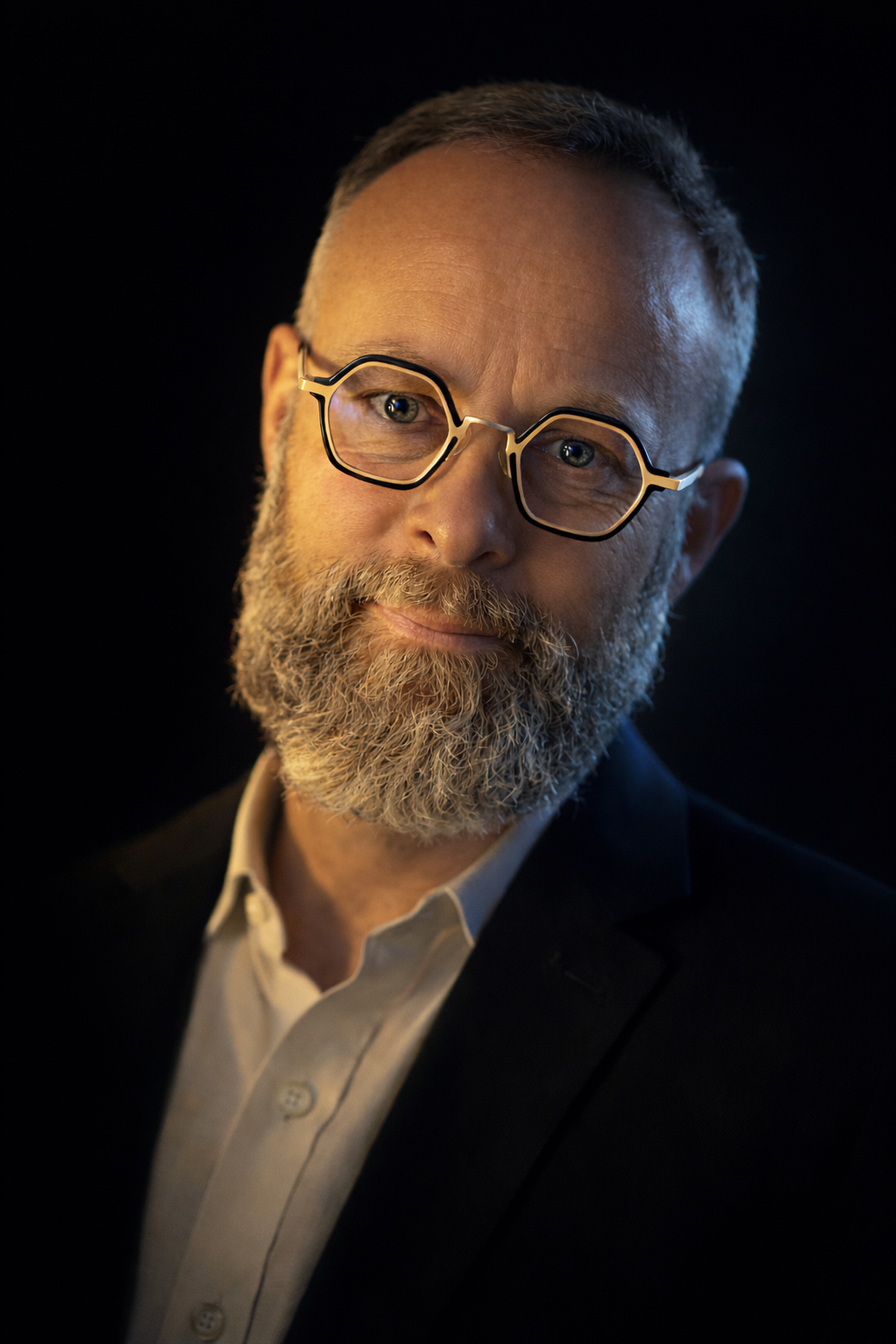
Wolfgang Schram
Wolf
Born in Germany and fluent in both German and English, Wolf lives with ADHD and dyslexia — traits he considers not limitations but the way his brain is wired. These cognitive advantages shaped a leadership style built on pattern recognition, empathy, and the ability to see what others walk past.
25 years across two continents. Started in broadcast engineering in Germany, moved to England, then California. Toured the world building live production systems for the biggest names in music. Led roughly 250 engineers globally. Now building what comes next — and opening doors for others to do the same.
I don’t drive people. I elevate them into who they need to be.
My greatest joy in leadership is seeing other people thrive. It’s never been about me. It’s about creating the environment where good people can do their best work.